Film Conducting
The Art of Live-to-Screen
Music Making the Cinema Come Alive.
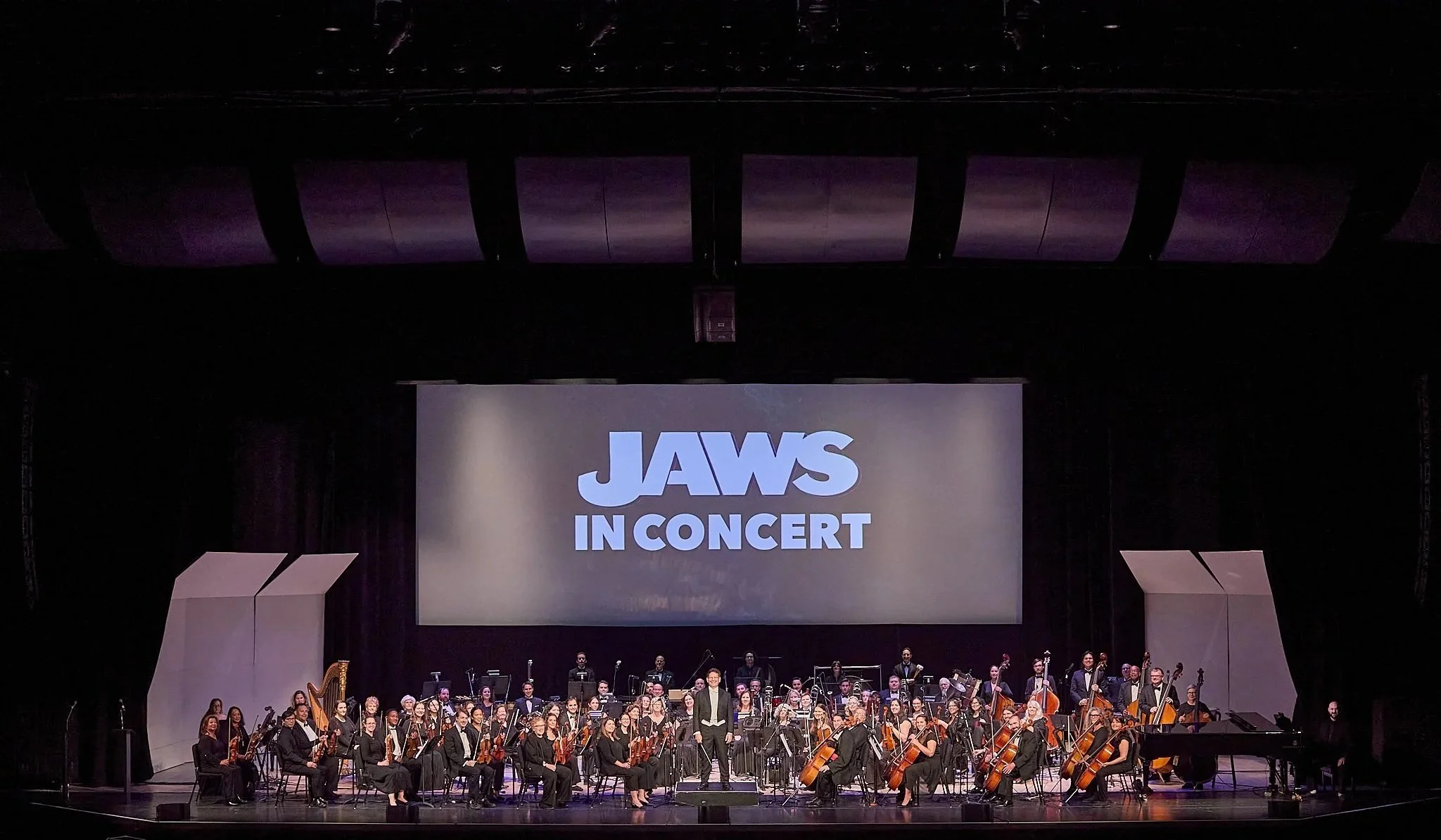
For David Bernard, live-to-screen conducting is far more important artistically than it is often given credit for.
Even the most advanced cinema sound systems deliver a fixed, recorded experience. A live orchestra is something fundamentally different. The sound fills the hall in a way that no recording can fully replicate. The music breathes. It responds to the room, to the audience, to the moment. When that living, breathing orchestra is synchronized to the images on screen — not mechanically, but through the real-time musical decisions of a conductor and ensemble — the result is an experience of cinema that audiences describe as unlike anything they have encountered before.
This is what makes live-to-screen productions so extraordinary — and so irreplaceable. They cannot be approximated by any other means. A film experienced with a live orchestra is the same film made newly alive — the composer's intentions realized in the most immediate and visceral way possible. Audiences feel it. Film producers understand it. And for symphony orchestras, live-to-screen programming represents one of the most powerful tools available for building new audiences and deepening existing ones.
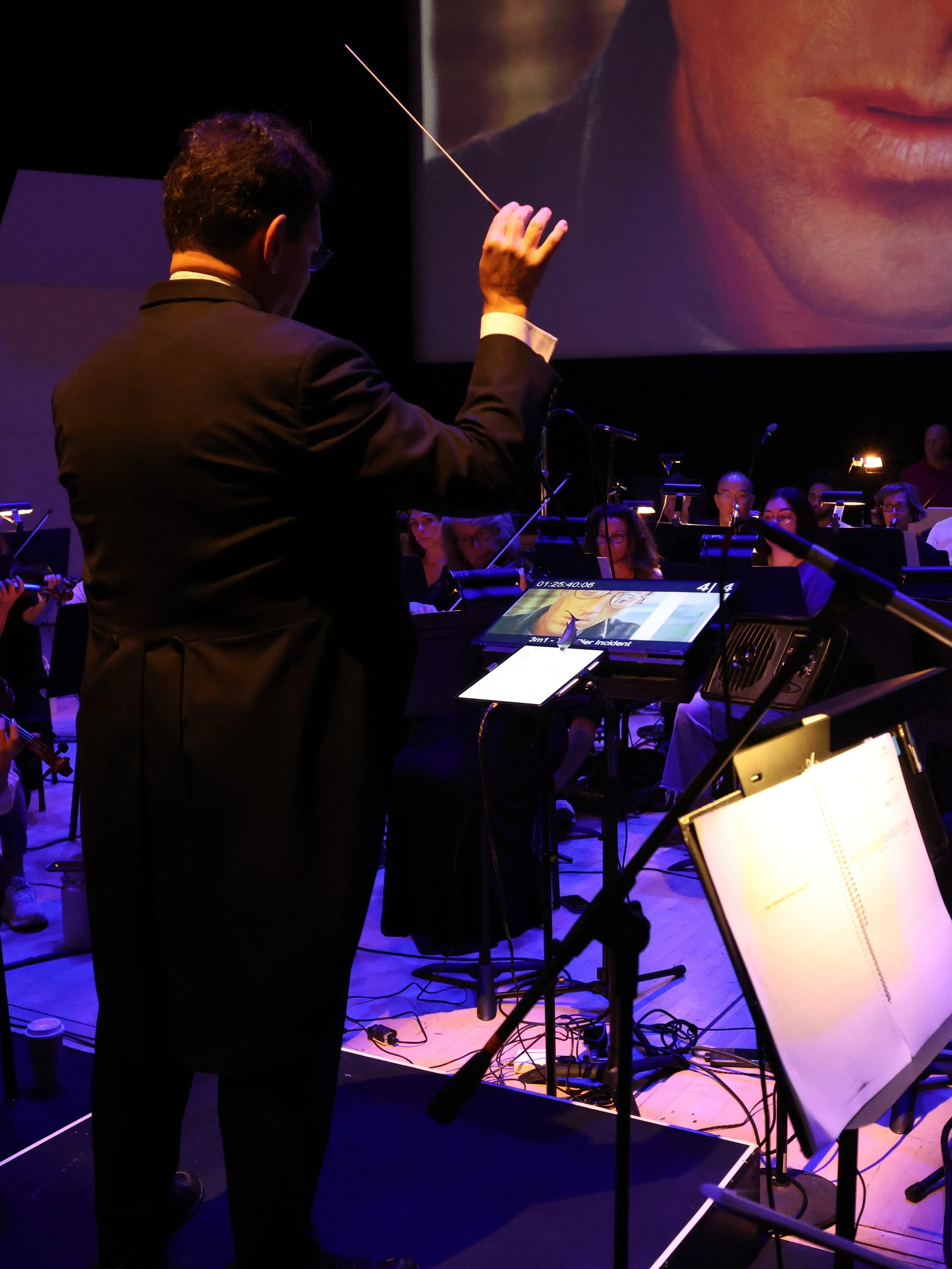
Bernard brings to this work the same interpretive rigor he applies to Mahler or Stravinsky. The score has to live and breathe as music even while tethered to the image. The orchestra has to feel free within the grid. The conductor's role is to hold those two demands in tension — artistic expression and perfect synchronization — and make them feel like one thing rather than two. Every musical decision happens in real time: the pacing of a silence, the weight of an explosion, the breath before a climactic chord, the surge of the music returning after a moment of stillness. These are conducting decisions, not technical ones.
For Bernard, this is the defining truth of film conducting: that the greatest film scores demand the same instincts as the greatest symphonic performances. The conductor who understands Mahler's silences understands Williams' silences. They are the same language.
"Live-to-screen conducting is not a mechanical exercise of following click tracks — it is the same artistic decision-making that happens in every great concert performance, now happening in real time while locked to a film." — David Bernard, Inside the Music
Cinematic Obsession
The Screen was always a Symphony.
David Bernard's relationship with film music did not begin at the podium. It began in childhood — with the soaring strings of Miracle on 34th Street, one of the first pieces of music that stopped him cold. Not as background, not as accompaniment, but as music that made the experience while something else was on screen.
From there the obsession deepened through the great film scores of the mid-twentieth century — Herrmann's vertigo-inducing strings, Rózsa's epic brass, Steiner's lush romanticism — each one revealing more of the same truth: that the greatest film composers were writing symphonic music, full stop.
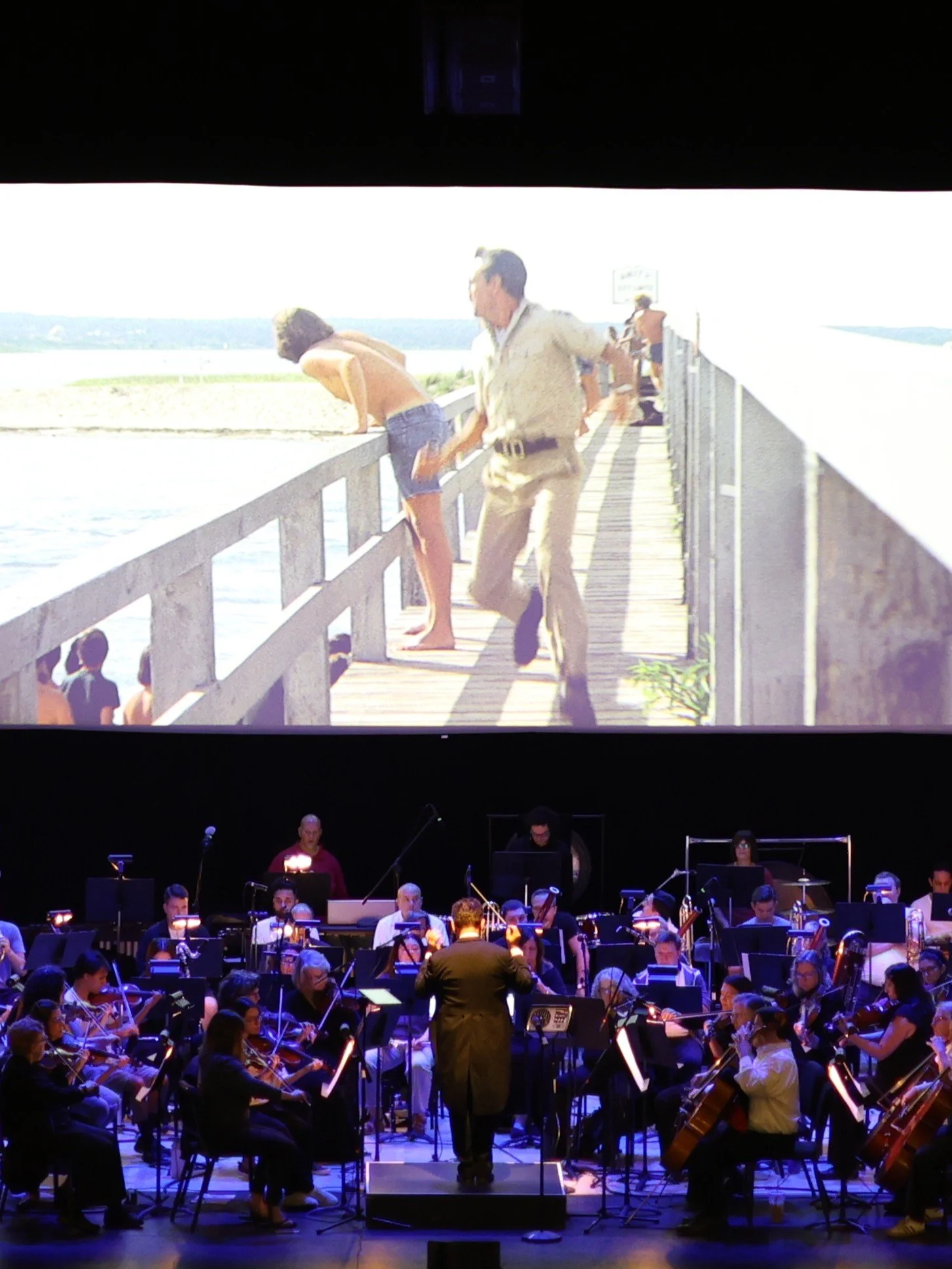
John Williams arrived in Bernard's life through Fitzwilly — not Star Wars, not Jaws, but an obscure 1967 comedy whose score announced a major compositional voice before the world had any idea what was coming. That early discovery shaped a lifelong conviction: that Williams' greatness was not a Hollywood phenomenon but a classical one, rooted in the same tradition as Stravinsky, Prokofiev, and Debussy. You can hear it directly in Jaws — Stravinsky's Rite of Spring surging through the shark battle sequences, Debussy's La Mer shimmering in the open ocean passages, Prokofiev lurking beneath the surface. Williams didn't borrow from these composers. He honored them, the way every great composer honors those who came before.
That conviction — that the screen was always a symphony — has shaped everything Bernard has brought to the podium as a film conductor. In the past year alone it produced a program pairing Holst's The Planets with John Williams, Jaws in Concert before 1,300 people at Tilles Center with two standing ovations, and a program pairing Williams with Shostakovich's Fifth Symphony that made the lineage explicit: the composer whose Fifth defined symphonic drama for a generation, and the composer who carried that tradition into the cinema.
"The greatest film scores aren't separate from the classical tradition. They are the classical tradition — projected onto a screen, heard by millions, and opening the door to the orchestra for people who never knew they were waiting." — David Bernard
The Undiscovered Country
A 34 Year Quest to Visit Praxis.
In December 1991, David Bernard sat in a movie theater and heard something that stopped him completely. Not just the film — it was the music.
Star Trek VI: The Undiscovered Country had been conceived as the final chapter of the original series — a deliberate farewell — and director Nicholas Meyer wanted everything about it to feel different. No familiar marches, no franchise comfort food. He wanted music that would announce something larger and more serious than what had come before. Composer Cliff Eidelman answered that call with a score of extraordinary symphonic ambition — an overture that opens with the dark, brooding weight of Stravinsky's Firebird, builds through layers of orchestral complexity, and culminates in an explosion of devastating power.
Bernard saw the film ten times in its initial theatrical run. Each time, for the music.
He left the theater knowing that overture belonged in a concert hall. For years he tried to make that happen — searching for the score and parts, coming up empty. The materials had been thrown in the vault after filming and never touched. There was no rental listing, no clear path to licensing. The overture existed only in the film.
For over two decades the search went nowhere. Then in early 2025 Bernard made one more attempt — this time going directly to the source. A cold outreach to composer Cliff Eidelman. Eidelman responded. Together they navigated the licensing process with Paramount Pictures, located the materials in the vault, and resolved every obstacle — within days of the premiere date.
On June 1, 2025, with the Massapequa Philharmonic, David Bernard conducted the world concert hall premiere of the Star Trek VI Overture — heard live for the first time in thirty-four years.
The audience understood immediately what they were witnessing. So did Bernard. A score of that ambition, that symphonic weight, that connection to the tradition he had spent his career conducting — finally heard the way it was always meant to be heard. In a concert hall. With a live orchestra.