The Persistence of Memories: Our Heartbeat
Recently I began a rehearsal Richard Strauss' Death and Transfiguration with the Park Avenue Chamber Symphony in Cary Hall at the DiMenna Center for Classical Music. The room went still. And then it began — quiet, slightly unstable pulses in the second violins and violas. A heartbeat. Tentative, a little fragile, but in its restraint telling you everything you need to know: sit back, release whatever you came in carrying, because where this is going is a long way away.
There is something particular about how substantial pieces begin. Not overtures, not curtain-raisers — but works that intend to take you somewhere far. They don't announce themselves. They arrive quietly, as if testing whether you are ready to make the journey. Strauss understood this completely. The opening of Death and Transfiguration doesn't ask for your attention. It earns it.
Standing there, shaping those first phrases, I felt what I always feel in this music — that conducting it is not directing it so much as inhabiting it. The phrases have to breathe through you. And as the opening unfolded in Cary Hall, another room surfaced in my memory. Another heartbeat. Another beginning.
Early in the work, before the great struggle has fully taken hold, Strauss depicts his protagonist's childhood memories. They don't arrive cleanly — they emerge the way memories actually do, through a kind of cloudy mist: harp arpeggios blurring the edges of time, and above them legato winds carrying the melodic fragments of a life's earlier chapters. It is one of the most precise musical descriptions of how memory works — not as retrieval but as emergence, shapes rising slowly through water. Every time I conduct that passage, my own memories surface through it. The passage depicts remembering — and it is itself a memory.
What surfaces is this: Room 309 at Juilliard. 1979. Fifteen years old.
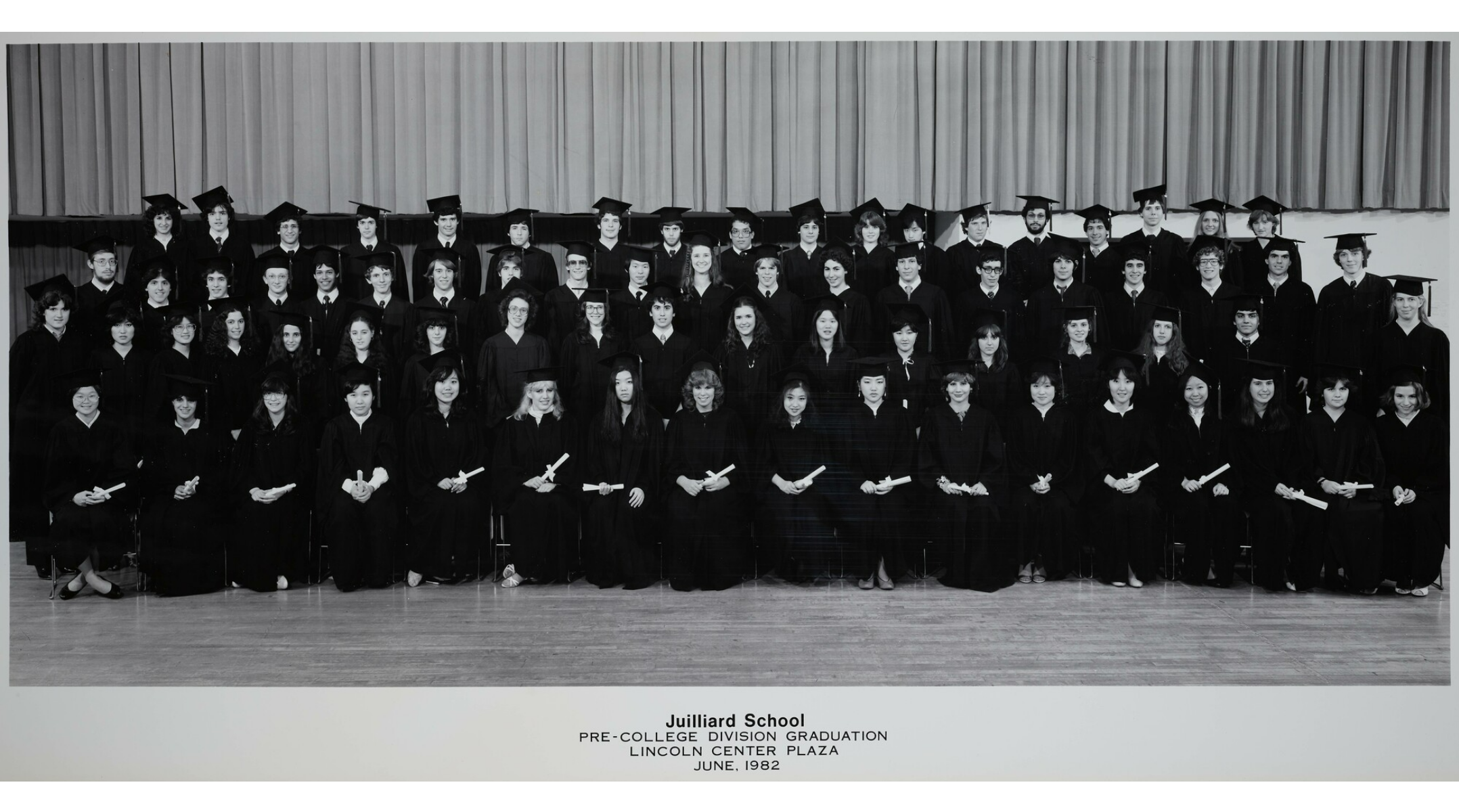
Juilliard Pre-College Division Class of 1982, photo taken in Room 309
It was my first rehearsal with the Pre-College Orchestra, the top ensemble in Juilliard's Pre-College Division, and I walked in nervous but also, underneath the nerves, certain that everything was about to be exactly right. That combination — anxiety and bedrock confidence existing simultaneously — is its own kind of knowledge. You don't reason your way into it. You just know.
What I found in that room was something I had never experienced before: for the first time in my life, I was surrounded entirely by people who understood. Not people who tolerated my obsession with music, or admired it from a polite distance — people who shared it completely, who had organized their entire young lives around it the same way I had. The relief of that is difficult to overstate. I had found my people.
But Juilliard Pre-College was not a sanctuary from pressure — it was pressure of a particular and clarifying kind. The standards were absolute. The expectations were unspoken but universally understood. Everyone in that room had already proven something just by being there, and everyone knew that proving it once was not enough. You were being formed — technically, musically, personally — in an environment that did not distinguish between those things. The challenge and the joy were the same thing.
And then there were the friendships. They formed the way friendships only form when stakes are high and passion is shared completely — quickly, deeply, with a permanence that none of us could have predicted at the time. The clarinetist sitting nearby, the flutist two stands over — a conversation before rehearsal that felt unremarkable in the moment and turned out to be the beginning of a relationship that would last decades. You don't know that yet, at fifteen. You just know that something is clicking into place.
I would encounter this same combination — the pressure, the standards, the sudden recognition of your people — twice more, at Tanglewood and then at the Curtis Institute of Music. But Juilliard Pre-College was the first. And the first time you understand something about yourself, it marks you differently than all the confirmations that follow.
At the podium that day was Roger Nierenberg — who would later become my conducting teacher, my mentor, and eventually my first boss in a conducting position, though none of that was visible yet. What was visible, immediately, was how completely he inhabited the music. His conducting didn't stand apart from the phrases and gesture at them — it glided and breathed with them, as though the music were moving through him rather than being directed by him. He set a culture in that room, wordlessly and completely: this is what it means to take music seriously. Not as performance, not as demonstration, but as a kind of living. It stayed with me. It still does. When I stand in front of an orchestra and try to dissolve into the phrase rather than conduct it, I am still, in some measure, in that room watching him.
Strauss wrote Death and Transfiguration at twenty-four. He had not yet lived what he was depicting. He had not watched himself age, had not felt the body weaken, had not sifted through a lifetime of memory in the final hours. What he had was imagination of an almost terrifying depth, and a command of philosophy and literature that let him construct the complete arc of a human life — from the first heartbeat to the last breath to whatever lies beyond — with the gravity of someone who had already traveled it. He hadn't. He just understood it.
There is something about that kind of understanding — precocious, earned through intensity rather than experience — that resonates with what it means to be fifteen at Juilliard. You haven't lived it either. But you understand it. The seriousness is real. The commitment is real. The relationships forming around you will turn out to be among the most lasting of your life, though you don't know that yet. Strauss at twenty-four and a clarinetist at fifteen are not so far apart: both constructing something from imagination and intensity, both reaching toward a gravity they have not yet earned through years but have earned through devotion.
Strauss' protagonist surveys his life from the threshold of death, and what he finds — beneath the struggle, the aspiration, the suffering — is transfiguration. The vision was worth it. The striving meant something.
In 1979, we were at the beginning of what that protagonist surveys from the end. We didn't know yet which conversations would become lifelong friendships, which teachers would become mentors, which mentors would shape not just how we played but how we thought about music and about life. Roger Nierenberg was standing at the front of the room. We were all, in our different ways, just beginning.
Back in Cary Hall, the heartbeat continues. The orchestra around me is different — decades have passed, rooms have changed, the clarinet is now a baton — but the music is the same, and so is what it asks of everyone in the room. Total commitment. Total presence. The understanding that every note matters because the listener is always the priority.
Strauss knew that at twenty-four. Nierenberg showed me that at fifteen. I am still exploring what it means.